

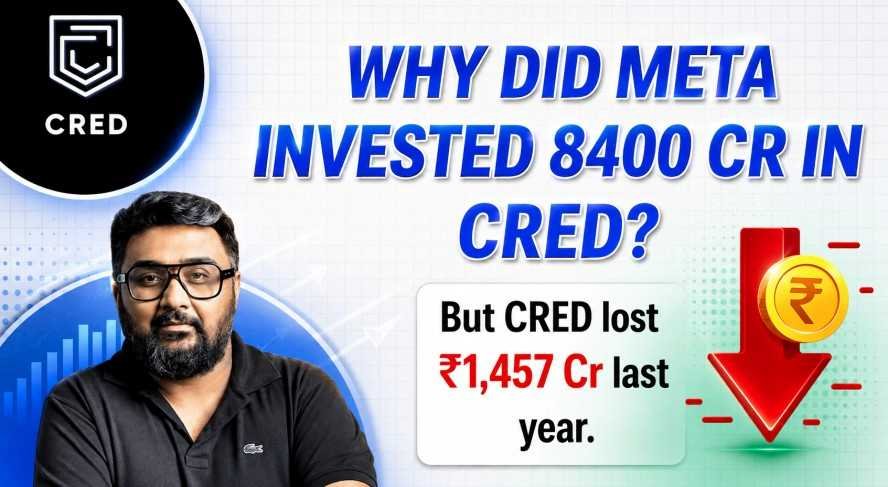
Meta’s recent investment in CRED has become one of the biggest talking points in India’s unlisted share market. The company reportedly invested around ₹8,400 crore, valuing CRED at approximately ₹41,830 crore. Naturally, the announcement sparked one question among investors: Why would Meta invest at such a premium valuation in a company that is still making losses?
At first glance, the numbers appear difficult to justify. In FY25, CRED generated ₹2,735 crore in revenue while reporting a net loss of ₹1,457 crore. At the latest CRED unlisted share price, the company is valued at nearly 15.3x Price-to-Sales (P/S) and 13.6x Price-to-Book (P/B). Those are rich multiples even by fintech standards.
Initially, I had the same view. But after comparing CRED with listed peers such as Paytm and MobiKwik, I realized that the market is valuing something much more important than today’s earnings. It is valuing the quality of CRED’s users, its monetization strategy and its long-term growth potential.
CRED Isn’t Trying to Become Another Paytm
Most people compare CRED with Paytm, PhonePe or Google Pay because all of them operate in digital payments. However, that comparison overlooks one critical difference.
Paytm, PhonePe and Google Pay have built businesses around scale. Their objective is to acquire as many users and transactions as possible. CRED follows a completely different strategy. Instead of targeting the mass market, it focuses exclusively on affluent Indians with strong credit profiles and high spending capacity.
Credit card bill payments are simply the customer acquisition tool. Once users join the platform, CRED cross-sells loans, UPI payments, insurance, wealth management, rewards, merchant offers and several premium financial products. Rather than maximizing the number of customers, the company focuses on increasing the lifetime value of every customer. That is the biggest reason why CRED deserves to be analyzed differently from traditional payment companies.
CRED Has a Much Smaller User Base
Let’s first compare monthly active users.
- Paytm: 7.2 crore users
- MobiKwik: 3.5 crore users
- CRED: 1.26 crore users
Looking only at user numbers, CRED appears significantly smaller. It has only around 17% of Paytm’s active users and roughly 36% of MobiKwik’s user base. If users were the only metric that mattered, CRED’s valuation would appear difficult to justify.
However, the story changes completely when we examine how those users actually transact.
Payment Volume Tells a Completely Different Story
Now compare the annual payment volume processed by these companies.
- Paytm: ₹18.9 lakh crore
- CRED: ₹8.5 lakh crore
- MobiKwik: ₹1.16 lakh crore
Despite having only 17% of Paytm’s user base, CRED already processes 44% of Paytm’s total payment volume. The comparison with MobiKwik is even more remarkable. While CRED has only around 36% of MobiKwik’s users, it processes more than seven times MobiKwik’s payment volume.
This immediately tells us that the average CRED customer spends far more than the average customer on competing fintech platforms. Instead of focusing on user quantity, CRED has built a platform around high-value customers with significantly larger transaction sizes.
Revenue Per User Is the Biggest Differentiator
The difference becomes even more obvious when we compare revenue generated per user.
- CRED: ₹2,171
- Paytm: ₹958
- MobiKwik: ₹320
CRED generates approximately 2.3 times the revenue per user compared to Paytm and almost 7 times the revenue generated by MobiKwik. This is perhaps the strongest evidence supporting CRED’s premium business model.
Another interesting statistic reinforces this point. Although CRED contributes only around 0.8% of India’s total UPI transaction volume, it accounts for nearly 2.5% of the total UPI transaction value. In simple words, CRED users make fewer transactions than the average UPI user, but every transaction is significantly larger.
This perfectly aligns with CRED’s strategy of targeting affluent Indians. Instead of chasing millions of low-value users, CRED has built a platform where every customer has higher purchasing power and therefore generates significantly higher economic value. That is exactly why the company is able to generate far higher revenue per user than its listed peers.
Revenue Yield Shows Strong Monetization
Another useful metric is revenue yield, which measures how much revenue a company earns from every rupee of payment volume.
- CRED: 0.32%
- Paytm: 0.36%
- MobiKwik: 0.66%
Although CRED’s revenue yield is slightly lower than Paytm’s and MobiKwik’s, it remains highly competitive considering the company’s relatively smaller customer base. More importantly, CRED’s strategy is not limited to payment processing. Payments are only the entry point for selling higher-margin financial products such as lending, insurance and wealth management. As these businesses continue to scale, monetization per customer is likely to improve further.
Growth Is One of the Biggest Reasons Behind the Premium Valuation
High-growth businesses almost always trade at premium valuations because investors pay for future earnings rather than current profitability.
Let’s compare revenue growth over the last five years.
- CRED: 96% Revenue CAGR
- Paytm: 20% Revenue CAGR
- MobiKwik: 17% Revenue CAGR
CRED’s revenue has grown at nearly 100% annually, far outpacing both Paytm and MobiKwik. This exceptional growth rate is one of the strongest reasons why investors are willing to assign significantly higher valuation multiples to the company. While current losses remain high, the market believes that CRED’s business model has the potential to generate much larger revenues over the coming years.
Valuation Comparison: Does CRED Deserve the Premium?
Let’s now compare valuation multiples.
Price-to-Sales (P/S)
- CRED: 15.3x
- Paytm: 8.59x
- MobiKwik: 1.41x
CRED trades at roughly 78% higher Price-to-Sales multiple than Paytm and more than 10 times MobiKwik’s multiple.
Price-to-Book (P/B)
- CRED: 13.6x
- Paytm: 4.48x
- MobiKwik: 2.93x
Similarly, CRED trades at nearly 3 times Paytm’s Price-to-Book multiple and more than 4 times MobiKwik’s valuation.
At first glance, these numbers suggest that CRED is expensive. However, premium businesses often trade at premium valuations because investors are pricing future cash flows rather than present-day earnings. While MobiKwik provides an additional benchmark, Paytm remains the more meaningful comparison due to its size and business mix.
Conclusion
CRED has positioned itself as one of India’s most unique fintech companies by focusing on affluent consumers instead of mass-market scale. While the company continues to report losses, its premium customer base, industry-leading revenue per user, high transaction values and exceptional revenue growth help explain why investors like Meta valued the company at ₹41,830 crore. Although the latest CRED share price reflects premium valuation multiples, the company’s long-term opportunity lies in its ability to further monetize its ecosystem across lending, payments, insurance and wealth management. For investors tracking CRED unlisted shares, or the potential CRED IPO, the key factor to watch is whether the company can translate its strong customer economics into sustainable profitability.
Why Choose The Unlisted Network?
Investing in unlisted shares requires more than just access to opportunities—it requires transparency, research, and execution support.
- Transparent Pricing: No hidden markups or surprise charges.
- Research-Driven Insights: Detailed company analysis, valuation frameworks, financial breakdowns, and industry research.
- Access to High-Quality Unlisted Opportunities: Explore leading pre-IPO, startup, and unlisted investment opportunities through a single platform.
- Structured Transaction Process: End-to-end support from price discovery and documentation to share transfer and settlement.
- Investor-Focused Approach: Helping investors make informed decisions through data-backed research and insights.
Final Note
CRED’s valuation may appear expensive today, but premium businesses often command premium valuations when backed by superior growth and strong customer economics. Investors considering CRED unlisted shares should focus not only on current financials but also on the company’s ability to sustain growth and achieve long-term profitability.
Disclaimer: This article is for informational and educational purposes only and should not be considered investment advice. Investors should conduct their own research and consult a qualified financial advisor before making any investment decisions.