

Garuda Aerospace Limited Unlisted Share Price
430
About Garuda Aerospace Limited Unlisted Share Price
ABOUT THE COMPANY:
Garuda Aerospace is one of India’s fastest-growing drone companies operating in the aerospace and defense industry. Founded in 2015 in Chennai by Agnishwar Jayaprakash and Rithika Mohan, the company started as a college project with an initial investment of nearly ₹50 lakh. Over the last decade, Garuda Aerospace has evolved into a major player in India’s drone ecosystem with a strong presence across agriculture, defense, mapping, mining, industrial inspection, disaster management, and drone-enabled services.
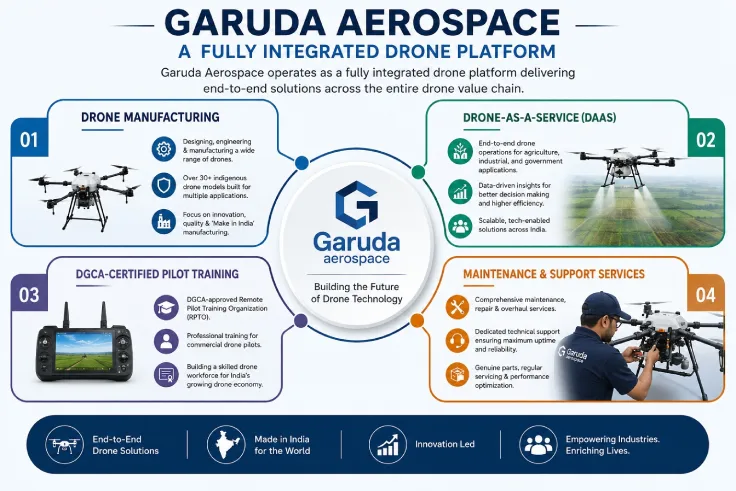
The company operates as a fully integrated drone platform rather than just a drone manufacturer. Its business model is built around four major verticals:
- Drone Manufacturing
- Drone-as-a-Service (DaaS)
- DGCA-certified Pilot Training
- Maintenance & Support Services
GLOBAL DRONE INDUSTRY MARKET SIZE:
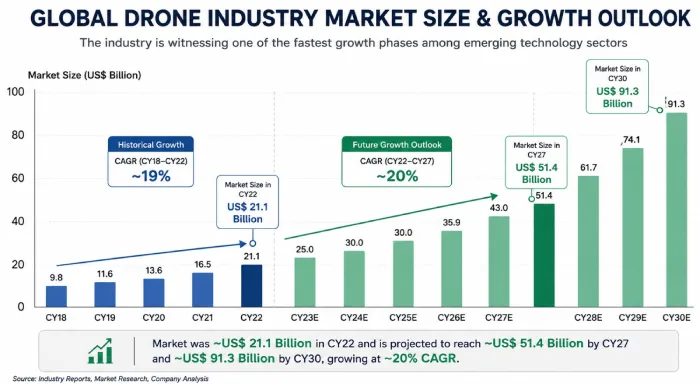
The global drone industry is witnessing one of the fastest growth phases among emerging technology sectors. The market was estimated at nearly US$21.1 billion in CY22 and has grown at a CAGR of around 19% between CY18-22. The industry is expected to grow even faster at nearly 20% CAGR and reach approximately US$51.4 billion by CY27 and nearly US$91.3 billion by CY30.
GLOBAL DRONE MARKET TRANSFORMATION:
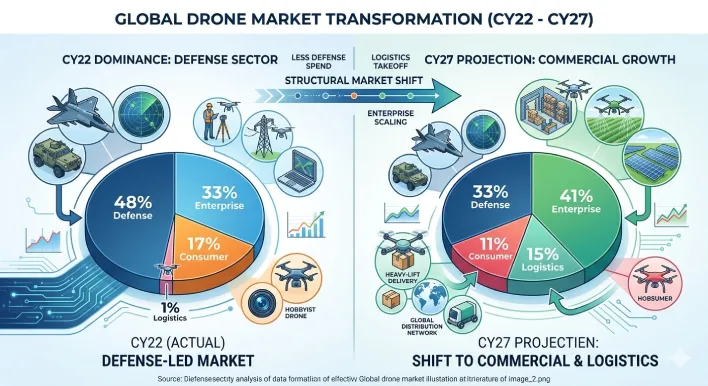
In CY22, the global drone market was largely dominated by the defense segment which accounted for nearly 48% of the total market. Enterprise applications contributed around 33%, consumer drones around 17%, while logistics remained very small at below 1%.
However, by CY27, the industry structure is expected to change significantly:
- Enterprise segment expected to rise to 41%
- Defense share expected to reduce to 33%
- Logistics expected to increase sharply to 15%
- Consumer segment expected at around 11%
This shift indicates that the next wave of growth may come more from commercial and industrial use cases rather than only military demand.
INDIAN DRONE INDUSTRY MARKET SIZE:
India’s drone ecosystem is entering a structural growth phase supported by government policy reforms and rising industrial adoption. The Drone Rules 2021 opened the sky for commercial drone operations by simplifying approvals and regulations. Along with this, the Production Linked Incentive (PLI) scheme is encouraging domestic drone manufacturing and component localization.
India’s drone market is estimated at nearly US$1.21 billion in 2024 and is expected to reach around US$2.58 billion by 2033.
India has also built a relatively regulated ecosystem with:
- 38,500+ registered drones
- 39,890 DGCA-certified remote pilots
- 244 approved training organizations
PRODUCTS & SERVICES:
Garuda Aerospace has built a diversified drone portfolio across agriculture, enterprise, and defense applications.
Product Categories
The company mainly operates across:
- Precision agriculture drones
- Industrial drones
- Defense drones
Its agriculture drones are used for:
- Precision spraying
- Crop health monitoring
- Seed spreading
- Pest and disease detection
- Pollination assistance
Industrial drones are used for:
- Survey and mapping
- Inspection and monitoring
- Videography
- Infrastructure assessment
Defense drones focus on:
- Surveillance
- Reconnaissance
- Tactical operations
DRONE AS A SERVICES (DAAS):
Apart from manufacturing, Garuda is increasingly building a recurring-service business through Drone-as-a-Service.
Its agriculture solutions include:
- Precision spraying
- Soil mapping
- Crop monitoring
- Harvest assistance
- Environmental monitoring
Safety and disaster management solutions include:
- Riot management
- Firefighting support
- Disaster relief operations
- Tear gas management
Industrial inspection solutions include:
- Mapping
- Monitoring
- Inspection
- Videography
This service-oriented approach can potentially improve recurring revenues and customer stickiness over the long term.
MANUFACUTRING CAPACITY:
Garuda Aerospace is aggressively expanding its manufacturing capabilities and focusing on localization.
The company currently operates:
- A 24,000 sq ft manufacturing facility in Chennai
- A new 35,000 sq ft Agri-Drone Indigenisation Facility near Thalambur
Current production capacity stands at around 8,000 drones annually, with plans to increase:
- To 15,000 drones in the near term
- To 50,000 drones over the long term
Production capacity has already doubled from:
- 12,000 units in FY25
- To 25,000 units targeted in FY26
REVENUE MIX:
Garuda Aerospace currently derives:
Around 70% revenue from agriculture
- 15-20% from defense
- 10-15% from enterprise applications
This indicates that agriculture remains the core growth engine for the company.
Promoter Background:
Garuda Aerospace was founded by Agnishwar Jayaprakash and Rithika Mohan, who transformed a small college project into one of India’s leading drone startups. Both founders come from management and business backgrounds and have played a key role in building Garuda Aerospace’s presence across agriculture, defense, and enterprise drone applications.
Agnishwar Jayaprakash – Founder & CEO
Agnishwar Jayaprakash leads the overall strategy and expansion of Garuda Aerospace. Under his leadership, the company has emerged as a major player in India’s drone ecosystem.
Education
- Business Law – Annamalai University
- MBA – Queens University of Charlotte
- PLD – Harvard Business School
Rithika Mohan – Co-Founder
Rithika Mohan has been instrumental in driving the company’s marketing, branding, and business development initiatives during its growth journey.
Education
- Business Management – Christ University
- PLD – Harvard Business School
Former Indian cricket captain MS Dhoni invested in Garuda Aerospace in 2022 and also serves as the company’s brand ambassador, significantly increasing the company’s visibility and brand recognition.
Key Partnerships
Garuda Aerospace has signed major international partnerships that strengthen its global positioning.
Airbus Helicopters Partnership
Garuda partnered with Airbus Helicopters for deployment of the advanced Flexrotor Uncrewed Aerial System.
Under this agreement:
- Garuda may acquire up to 18 Flexrotor systems
- Focus areas include defense and long-endurance surveillance
- The partnership supports Garuda’s global leasing ambitions
- This significantly strengthens Garuda’s capabilities in advanced ISTAR operations.
Lockheed Martin Partnership
Garuda also partnered with Lockheed Martin CDL Systems.
The partnership focuses on:
- Integrating Indian drone hardware with advanced UAS software
- Joint development of mapping and analytics solutions
- Applications across agriculture, mining, and industrial inspection
Funding & Valution Overview :
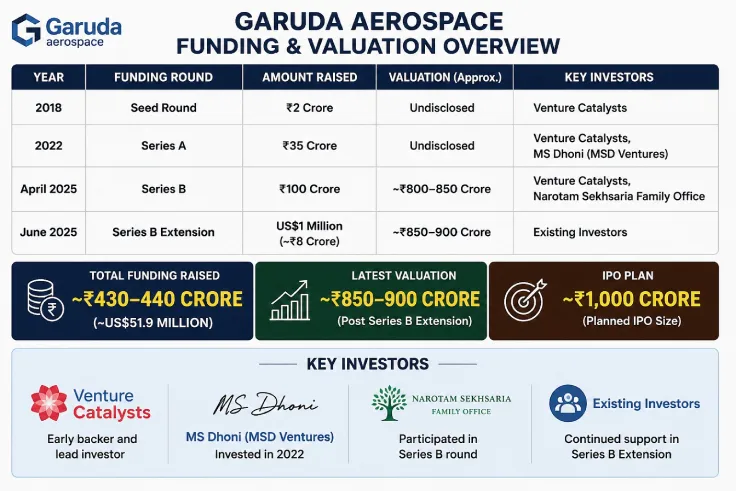
Garuda Aerospace has raised funding across seed, Series A, and Series B rounds from investors including Venture Catalysts and MS Dhoni’s investment firm. The company has reportedly raised nearly US$51.9 million to support manufacturing expansion, technology development, and drone service operations. It is now preparing for a proposed ₹1,000 crore IPO.
FINANCIAL PERFORMANCE:
Garuda Aerospace has delivered strong financial growth over the last few years as drone adoption accelerated across agriculture, defense, and enterprise applications. The company’s revenue grew sharply from ₹47 crore in FY23 to ₹205 crore in FY26, representing nearly 63% growth in just two years. This reflects rising demand for precision agriculture drones and drone-enabled services.
Profitability also improved during the period. EBITDA increased from ₹10.9 crore in FY23 to ₹38 crore in FY26, while PAT grew from ₹6.2 crore to ₹25.92 crore, reflecting nearly 179% PAT growth. Despite rapid expansion, PAT margins remained relatively stable at around 13.9% in FY23 and 12.59% in FY26.
However, gross margins came under pressure during the period. Gross margin declined from nearly 80% to around 42.85%, mainly due to dependence on imported components such as motors, controllers, and sensors. This highlights the importance of the company’s ongoing localization and indigenization strategy.
Balance Sheet & Working Capital
One of the biggest concerns for Garuda Aerospace is its stretched working capital cycle. Receivable days increased sharply from 332 days in FY25 to 415 days in FY26, indicating slower collections from customers. Inventory days also remained elevated due to scaling operations and manufacturing expansion.
As a result, the company’s cash conversion cycle increased from 329 days in FY23 to 362 days in FY26. This indicates that a large amount of capital remains tied up in receivables and inventory, creating pressure on operating cash flows and increasing funding requirements during expansion.
Peer Comparison & Valuation
IdeaForge Technology remains one of the key listed peers in India’s drone industry. While IdeaForge revenue declined from ₹314 crore in FY24 to ₹226 crore in FY26, Garuda Aerospace delivered significantly faster growth with revenue increasing from ₹47 crore to ₹205 crore during the same period.
In valuation terms, IdeaForge trades at around 994 P/E and 5.68 x P/B, while Garuda reportedly trades at nearly 86x P/E and 9.45 x P/B. Garuda commands premium valuation expectations due to its faster growth trajectory, leadership in agricultural drones, service-led business model, and aggressive manufacturing expansion.
However, both companies continue to operate with very high working capital cycles. IdeaForge’s cash conversion cycle remained extremely elevated at around 667 days in FY23 and nearly 587 days in FY26, while Garuda’s increased from 280 days to 362 days. This highlights one of the key financial risks in the drone industry where delayed collections and large institutional contracts can significantly impact cash flows.
Key Risks:
- Dependence on imported motors, controllers, and sensors can impact margins and supply chain stability
- High receivable days and stretched cash conversion cycle may pressure cash flows
- Nearly 70% revenue comes from agriculture, creating sector concentration risk
- Drone regulations and defense policies can change rapidly
- Rising competition from domestic startups, defense-focused players, and global drone manufacturers
- Rapid technological changes require continuous R&D and innovation spending
CONCLUSION
Garuda Aerospace has emerged as one of India’s fastest-growing drone companies, benefiting from strong industry tailwinds, government support, and rising adoption of drones across agriculture, defense, and enterprise applications. The company has built a diversified drone ecosystem through manufacturing, Drone-as-a-Service, pilot training, and maintenance solutions.
Its strong revenue growth, leadership in agricultural drones, strategic partnerships with global aerospace players, and focus on indigenous manufacturing position it well for long-term growth in India’s expanding drone market.
However, the company also faces key challenges including high working capital intensity, dependence on imported components, and elevated valuation expectations. Going forward, Garuda’s ability to improve localization, manage cash flows, and scale operations efficiently will be critical in determining whether it can emerge as a long-term leader in India’s drone ecosystem.
Fundamentals
| Garuda Aerospace Limited | ₹ 430 | Market Cap (in cr.) | ₹ 2440 |
| Unlisted Shares Price | Per Equity Share | P/E Ratio | 86 |
| Lot Size | 100 Shares | P/B Ratio | 9.45 |
| 52 Week High | ₹ 495 | Debt to Equity | 0.002 |
| 52 Week Low | ₹ 468 | ROE (%) | 12.78% |
| Depository | NSDL & CDSL | Book Value | 34.16 |
| PAN Number | AAGCG1621A | Face Value | 2 |
| ISIN Number | INE0REL01013 | Total Shares | 52135780 |
| CIN | U74900TN2015PLC102474 | ||
| RTA | KFin Technologies |
Financial
| P&L Statement | 2023 | 2024 | 2025 | 2026 |
|---|---|---|---|---|
| Revenue | 47 | 110 | 123.46 | 205.96 |
| Cost of Material Consumed | 10.8 | 50 | 72.32 | 116.82 |
| Change in Inventory | -1.3 | -1.2 | -16.59 | 1.82 |
| Gross Profit | 37.5 | 61.2 | 65.89 | 88.32 |
| Gross Margins | 79.79 | 55.64 | 53.37 | 42.88 |
| Employee Benefit Expenses | 8.6 | 10.6 | 9.55 | 8.02 |
| Other Expenses | 18 | 26 | 29.13 | 29.21 |
| EBITDA | 10.9 | 24.6 | 28.79 | 38.42 |
| OPM | 23.19 | 22.36 | 23.32 | 18.65 |
| Other Income | 0 | 0.8 | 1.35 | 0.27 |
| Finance Cost | 0.9 | 1.92 | 1.23 | 1.04 |
| D&A | 1.5 | 1.98 | 3.6 | 4.08 |
| EBIT | 9.4 | 22.62 | 25.19 | 34.34 |
| EBIT Margins | 20 | 20.56 | 20.4 | 16.67 |
| PBT | 8.4 | 21.3 | 25.41 | 34.06 |
| PBT Margins | 17.87 | 19.36 | 20.58 | 16.54 |
| Tax | 2.2 | 5.5 | 7.04 | 8.15 |
| PAT | 6.2 | 15.8 | 18.37 | 25.92 |
| NPM | 13.19 | 14.36 | 14.88 | 12.59 |
| EPS | 579.44 | 1436.36 | 3.67 | 4.99 |
Financial Ratios |
2023 | 2024 | 2025 | 2026 |
|---|---|---|---|---|
| Operating Profit Margin | 23.19 | 22.36 | 23.32 | 18.65 |
| Net Profit Margin | 13.19 | 14.36 | 14.88 | 12.59 |
| Earning Per Share (Diluted) | 579.44 | 1436.36 | 3.67 | 4.99 |
| Assets | 2023 | 2024 | 2025 | 2026 |
|---|---|---|---|---|
| Fixed Assets | 6.8 | 13.7 | 15.17 | 17.98 |
| CWIP | 0 | 0 | 3.53 | 3.15 |
| Investments | 0 | 0 | 0.5 | 0.5 |
| Trade Receivables | 37.7 | 73.8 | 111.95 | 234.4 |
| Inventory | 1.35 | 26 | 24.59 | 34.27 |
| Other Assets | 11.15 | 35.5 | 32 | 25.01 |
| Total Assets | 57 | 149 | 209.03 | 359.62 |
| Liabilities | 2023 | 2024 | 2025 | 2026 |
|---|---|---|---|---|
| Share Capital | 0.107 | 0.11 | 0.11 | 9.65 |
| FV | 10 | 10 | 10 | 10 |
| Reserves | 29.8 | 104.7 | 165.48 | 230.2 |
| Borrowings | 14.7 | 19.7 | 0.46 | 0 |
| Trade Payables | 1.6 | 15.7 | 25.82 | 64.56 |
| Other Liabilities | 10.79 | 8.79 | 10.5 | 25.09 |
| Total Liabilities | 57 | 149 | 209.03 | 359.62 |
| Cash-Flow Statement | 2023 | 2024 | 2025 | 2026 |
|---|---|---|---|---|
| PBT | 8.4 | 21.3 | 25.41 | 34.06 |
| OPBWC | 13.2 | 25 | 30.23 | 50.34 |
| Change in Receivables | -23.3 | -36 | -20.05 | -133.56 |
| Change in Inventories | -1.3 | -24.8 | 1.57 | -9.68 |
| Change in Payables | 1.6 | 14 | 10.69 | 38.73 |
| Other Changes | -13.95 | -12.2 | -42.89 | -27.96 |
| Working Capital Change | -36.95 | -59 | -50.68 | -132.47 |
| Cash Generated From Operations | -23.75 | -34 | -20.75 | -34.93 |
| Tax | -0.95 | -7.3 | -2.89 | -6.62 |
| Cash Flow From Operations | -24.7 | -41.3 | -23.64 | -41.55 |
| Purchase of PPE | -4.3 | -8.9 | -15.3 | -13.31 |
| Sale of PPE | 0 | 0 | 0 | 0 |
| Cash Flow From Investment | -6.4 | -12.3 | -15.93 | -19.46 |
| Borrowing | -14.7 | 4.9 | -39.3 | 48.99 |
| Dividend | 0 | 0 | 0 | 0 |
| Equity | 17.28 | 58.08 | 47.14 | 17.74 |
| Others From Financing | 29.12 | -1.08 | 22.88 | -15.27 |
| Cash Flow From Financing | 31.7 | 61.9 | 30.72 | 51.46 |
| Net Cash Generated | 0.6 | 8.3 | -8.86 | -9.54 |
| Cash at the Start | 1.08 | 1.6 | 9.81 | 0.95 |
| Cash at the End | 1.68 | 9.9 | 0.95 | -8.59 |
Promoters or Management
| Name | Designation | Experience | Linkedin Profile |
|---|---|---|---|
| Agnishwar Jayaprakash | Whole Time Director, CEO | 10+ |  |
| Rithika Mohan | Whole Time Director | 10+ | |
| Sudarshan Ravichandran | CFO | 15+ | |