

Motilal Oswal Housing Finance which is trading in the unlisted market 9.75 per share reported a 20% year-on-year growth in revenue for Q2 FY27, supported by strong loan disbursements and expansion in its assets under management (AUM). However, profit growth remained relatively muted, with profit after tax (PAT) increasing by just around 6% during the quarter.
Revenue increased to ₹230.62 crore in Q2 FY27, compared with ₹191 crore in Q2 FY26. In comparison, PAT grew from ₹34 crore to ₹36 crore during the same period. The gap between revenue and profit growth remains an important aspect of the company’s latest quarterly performance.
AUM grows to ₹6,476 crore; disbursements increase 29%
Motilal Oswal Housing Finance continued to expand its lending operations during the quarter. Its assets under management increased from ₹5,236 crore to ₹6,476 crore, reflecting growth in its loan portfolio.
Loan disbursements increased 29% year-on-year to ₹701 crore in Q2 FY27, compared with ₹544 crore in Q2 FY26. The growth was also visible in the half-year performance, with disbursements increasing from ₹940 crore in H1 FY26 to approximately ₹1,348 crore in H1 FY27, registering growth of around 43%.
Net Interest Income (NII) increased 14% to ₹108 crore in Q2 FY27, compared with ₹95 crore in the corresponding quarter last year. The growth in AUM, disbursements and NII indicates continued expansion in the company’s lending business.
Why is PAT growth lagging revenue growth?
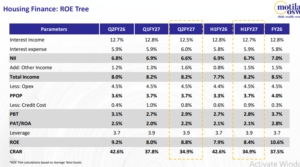
Despite healthy growth in revenue and loan disbursements, the company’s return ratios declined during the quarter. Return on Assets (ROA) fell from 2.5% in Q2 FY26 to 2.2% in Q2 FY27, while Return on Equity (ROE) declined from 9.2% to 8.8%.
The company’s ROE Tree highlights two important factors behind this moderation: pressure on interest margins and higher credit costs. Interest income, as a percentage of average assets, declined from 12.7% to 12.5%, while interest expenses increased from 5.9% to 6%. Consequently, the NII margin component declined from 6.8% to 6.6%, indicating some pressure on the spread between lending yields and borrowing costs.
Credit costs double from 0.4% to 0.8%
Another important factor affecting profitability was the increase in credit costs. Credit costs doubled from 0.4% in Q2 FY26 to 0.8% in Q2 FY27. Credit costs represent expenses recognised towards potential loan losses, including provisions, and directly affect the profitability of a lending business.
Interestingly, the increase came even as the company’s reported asset quality ratios remained stable, with Gross Non-Performing Assets (GNPA) at 1.5% and Net Non-Performing Assets (NNPA) at 0.9%. However, stable GNPA and NNPA do not necessarily mean credit costs will remain unchanged. While these ratios reflect the level of non-performing loans, credit costs capture the expenses recognised against potential loan losses during a particular period.
PPOP improves, but higher credit costs weigh on profitability
The company’s operating performance presents a relatively positive picture. Pre-Provision Operating Profit (PPOP) margin improved marginally from 3.6% in Q2 FY26 to 3.7% in Q2 FY27, while operating expenses remained stable at 4.5% of average assets.
However, the increase in credit costs offset the improvement in operating profitability. Consequently, PBT margin declined from 3.1% to 2.9%, while ROA moderated from 2.5% to 2.2%. This indicates that although the company improved its operating profitability, higher credit-loss expenses limited the improvement in its bottom line.
The company’s Capital to Risk-Weighted Assets Ratio (CRAR) declined from 42.6% in Q2 FY26 to 34.9% in Q2 FY27. CRAR measures the capital available to absorb potential losses relative to risk-weighted assets. Although the ratio remains at a substantial level, its decline is worth monitoring as the company continues to expand its loan book.
What should the Motilal Oswal Housing Finance Unlisted Investor should do now ?
Motilal Oswal Housing Finance’s Q2 FY27 performance reflects strong growth in its lending operations, with AUM expanding, disbursements growing 29% and revenue increasing 20% year-on-year. However, slower PAT growth, higher credit costs and declining return ratios indicate that converting loan book expansion into improved profitability remains a challenge.
Going forward, the company’s ability to manage borrowing costs, control credit expenses and improve its return ratios will be important factors to watch. The trajectory of credit costs and net interest margins will be particularly important in determining whether the company’s strong business growth can translate into better shareholder returns.