

The global drone industry is entering one of the fastest expansion phases among emerging technology sectors. What started largely as a defense-driven market is now rapidly shifting toward enterprise and commercial applications.
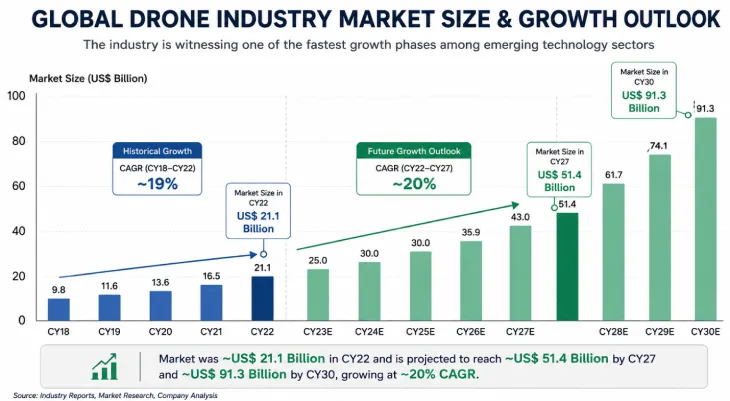
The global drone market was estimated at nearly US$21.1 billion in CY22 and grew at around 19% CAGR between CY18–22. The industry is expected to accelerate further and reach nearly US$51.4 billion by CY27 and almost US$91.3 billion by CY30.
But the bigger story is not just growth.It is the structural shift happening inside the industry.
The Global Drone Industry Is Changing Rapidly
In CY22, defense dominated the global drone market with nearly 48% market share. Enterprise applications contributed around 33%, consumer drones about 17%, while logistics remained extremely small.
However, by CY27, the industry structure is expected to look very different:
- Enterprise segment expected to rise to nearly 41%.
- Defense share expected to decline to around 33%.
- Logistics expected to surge to nearly 15%.
- Consumer drones expected around 11%.
This indicates that the next wave of growth may come not just from military demand, but from real-world commercial use cases such as agriculture, infrastructure, logistics, and industrial automation.
And this is exactly where Garuda Aerospace quietly positioned itself early.
From ₹50 Lakh Startup to Agriculture Drone Leader
Garuda Aerospace started with an initial investment of nearly ₹50 lakh. Instead of competing only as a drone manufacturer, the company focused on building specialized indigenous drones for agriculture and enterprise use cases. Over time, this strategy helped the company emerge as one of India’s leading agriculture drone players, with an estimated market share of over 50% in the agriculture drone segment. But what truly differentiated Garuda was not simply selling drones. The company focused on building solutions around agriculture through its service-led approach, positioning itself beyond pure hardware manufacturing and creating a scalable Drone-as-a-Service business model.
The Real Differentiator: Drone-as-a-Service (DaaS)
Anyone can manufacture drones, but Garuda Aerospace realized early that the real long-term opportunity may not come from simply selling hardware. Instead, the company understood that creating practical solutions for farmers and enterprises could build a far more scalable and recurring business model. This led Garuda to develop its Drone-as-a-Service (DaaS) platform, where drones are not just sold as products but deployed as operational tools for agriculture and enterprise applications. Through this model, the company provides specialized solutions such as precision spraying, seed spreading, pest and disease detection, pollination support, and crop health monitoring, helping position Garuda as a technology solutions provider rather than just a drone manufacturer.
Their services include:
- Precision spraying
- Seed spreading
- Pest and disease detection
- Pollination support
- Crop health monitoring
This approach shifted Garuda Aerospace from being just a drone hardware seller to becoming an agriculture technology solutions provider. The transition is clearly visible in the company’s revenue mix. In FY24, Drone-as-a-Service (DaaS) contributed nearly 62% of total revenue, while drone sales accounted for around 38%. This helped the company build a more recurring, scalable, and service-driven business model compared to traditional pure hardware manufacturing players.
Financial Growth That Quietly Surprised the Market
The impact of this strategy gradually became visible in the financial performance of Garuda Aerospace. The company’s revenue grew from nearly ₹47 crore in FY23 to around ₹117 crore in FY25, representing almost 149% growth within just two years. Profitability also improved significantly during the same period. PAT increased from around ₹6.2 crore to nearly ₹17.3 crore, reflecting growth of approximately 179%. The strong growth was driven by rising agriculture drone adoption, increasing contribution from the Drone-as-a-Service (DaaS) segment, and the company’s focus on building recurring operational solutions instead of depending only on hardware sales.
The company benefited from:
- Increasing agriculture drone adoption
- Service-led recurring revenue
- Strong industry tailwinds
- Better customer stickiness through DaaS
Garuda Aerospace vs IdeaForge : A Very Different Strategy
One of the most interesting comparisons in the Indian drone ecosystem is between Garuda Aerospace and IdeaForge. While both companies operate in the drone industry, their business exposure and strategic focus are completely different. IdeaForge has remained largely dependent on defense and surveillance applications, whereas Garuda Aerospace focused aggressively on agriculture, enterprise applications, and service-led drone solutions. This difference in positioning became increasingly important as commercial drone adoption started expanding beyond military use cases.
Revenue Mix Difference
- IdeaForge derives nearly 70% of revenue from defense
- Garuda Aerospace derives nearly 70% from agriculture
This difference became extremely important during FY23–FY25.
Revenue Comparison
During this period:
- IdeaForge revenue declined from around ₹186 crore to ₹161 crore
- Garuda Aerospace revenue increased from ₹47 crore to ₹117 crore
This highlights how commercial agriculture demand remained relatively stronger and more scalable during this phase.
Working Capital Challenges Exist, but Better Than Peers:
Another important difference between Garuda Aerospace and IdeaForge is working capital efficiency. Drone businesses often struggle with long receivable cycles and delayed payments, especially companies heavily dependent on defense contracts. However, Garuda’s agriculture-focused and service-led model helped improve its cash flow dynamics comparatively. The company reported a cash conversion cycle of around 351 days, significantly lower than IdeaForge’s nearly 597 days. Although Garuda still operates with a relatively high working capital cycle, its operational structure appears more efficient compared to several defense-heavy peers in the industry.
Valuation
The market is also assigning different expectations to both companies. Garuda Aerospace trades at an estimated Price-to-Book valuation of around 13.2x, while IdeaForge trades closer to nearly 6.1x. This difference suggests that investors may be pricing in stronger long-term growth expectations for Garuda Aerospace, particularly due to its agriculture exposure, service-led business model, and positioning in the expanding commercial drone ecosystem
Strategic Investors and IPO Plans
The company’s rise has also attracted high-profile investors and strategic backers.
Some notable shareholders include:
- Mahendra Singh Dhoni
- Lockheed Martin
- Venture Catalysts
Now, Garuda Aerospace is preparing for its IPO.
The proposed issue size is expected to be around ₹1,000 crore, including:
- ₹750 crore fresh issue
- ₹250 crore offer for sale (OFS)
The IPO could become one of the most closely watched listings in India’s emerging drone ecosystem.
Conclusion:
The Indian drone industry is gradually shifting from defense-led demand toward commercial and enterprise applications. Garuda Aerospace identified this opportunity early by focusing on agriculture and building a Drone-as-a-Service (DaaS) model instead of depending only on hardware sales. Its service-led approach, improving financial performance, and partnerships with global players like Lockheed Martin and Airbus helped the company emerge as one of India’s fastest-growing drone players.